 Zambezi River Tours
Victoria Falls Moonbow: Lunar Rainbow Dates, Months and Tickets
The Victoria Falls moonbow is a lunar rainbow that forms in the spray of the falls on the three nights around each full moon. It is one of the few places on earth where the phenomenon recurs predictably, and both Zimbabwe and Zambia open their national parks after dark to show it. This page covers the full moon dates, the best months for strong spray and clear skies, the viewpoints on each side, and what night entry costs. It also covers the practical side of the evening, from photographing a faint arc to planning dinner on the river beforehand. For the daylight hours around a moonbow night, compare the Victoria Falls river tours and the cruises and rafting trips.
Quick answer Moonbow in one minute
The Victoria Falls moonbow shows on three nights of every lunar cycle: the night before the full moon, the night of it, and the night after. It is best in the high-water months when spray fills the gorge, roughly February to August. You see it only on special night entry at Victoria Falls Rainforest in Zimbabwe or Mosi-oa-Tunya National Park in Zambia, on the same three nights.
Key takeaways
- Full moon dates for the viewing window: full moon dates
- What night entry costs on each side: tickets and hours
- Which months give the strongest moonbow: best months
- Fill the evening with a river cruise: dinner cruise options
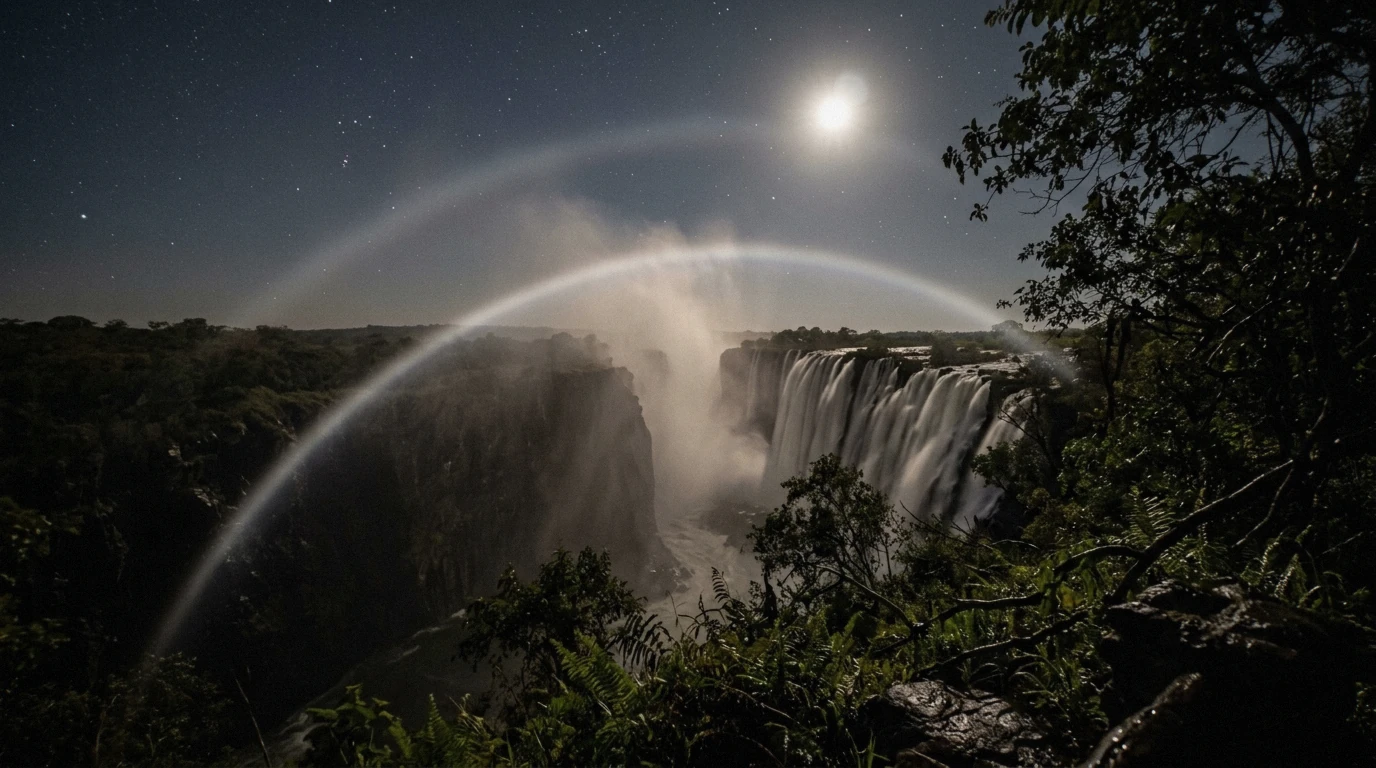
The moonbow shows around the full moon.
What the Lunar Rainbow Is
A moonbow uses the same optics as a daytime rainbow, with moonlight standing in for the sun.
Same Physics, Weaker Light
A lunar rainbow forms through refraction, reflection and dispersion of light in airborne water droplets, exactly like a daytime rainbow. The difference is the light source. Moonlight reflected off the sun is far dimmer than direct sunlight, which is why moonbows are rarer and fainter than rainbows. Dr Kimberly Strong, a physics professor at the University of Toronto, notes that they are best seen when the moon is near full and at its brightest.
Four conditions must line up at once. The moon must be low in the sky. Skies must be free of cloud. There must be enough spray droplets in the air. And you must stand with the moon behind you and the spray in front of you. At Victoria Falls the falls provide the spray and the parks open on the right nights, which is why the falls have become the most cited place on earth to see one.
What It Actually Looks Like
Manage expectations before you go. To the naked eye a moonbow usually looks pale, white or washed out, because the low light is too faint to strongly excite the color-sensing cone cells in the human retina. How much color a person sees varies with individual night vision, so some visitors find it underwhelming if they expect a bright daytime rainbow.
One journalist described it as a pale smudge in the spray that slowly resolved into a soft arc, with diffused light, subdued colors and softer edges than a daytime rainbow. A guide interviewed by the BBC, Omen Mudenda of Victoria Falls Expeditions, describes the experience as feeling almost spiritual to many guests, standing in darkness, hearing and feeling the falls, then suddenly seeing a rainbow made of moonlight. Cameras see more than eyes do, which the photography section below explains.
Moonbows were first documented by Aristotle in his treatise Meteorology, written around 350 BC. Other places with recurring natural moonbows include Yosemite Falls and Cumberland Falls in the United States, Wallaman Falls in Australia, and Kihei on Maui. Moonbows used to appear at Niagara Falls but stopped because of surrounding light pollution, a cautionary example for development around Victoria Falls.
Sources: Lunar rainbow tour, Wild Horizons, Victoria Falls lunar rainbow, Ilala Lodge
Full Moon Dates for Moonbow Viewing
The viewing window is three nights per lunar cycle, so the dates matter more than anything else on this page.
The Three-Night Window
A lunar rainbow is visible on only three nights of each lunar month: the night before the full moon, the night of the full moon, and the night after, when moonlight is brightest. Victoria Falls National Park opens the Rainforest on Zimbabwe side for guided viewing on exactly those three nights, and Mosi-oa-Tunya National Park on Zambia side does the same. Within each night, the moonbow is best in the hours soon after moonrise, before the moon climbs too high, which is why the gate opening times are timed to that window and differ between summer and winter.
The table lists the 2026 full moon dates as commonly reported in US Eastern Time. Victoria Falls and Livingstone run 7 to 9 hours ahead of US Eastern Time, so a full moon peaking very late in the US day can fall on the next calendar date locally. Cross-check the exact local date and time on timeanddate.com before booking a night tour. No single source confirms the precise local Central Africa Time date for each full moon.
2026 and 2027 Full Moon Dates
The dates below come from aggregated astronomy calendar sources, including the Old Farmer's Almanac, Live Science and Astronomy.com for 2026, and Catalina Sky Survey, Fullmoonology and Wikipedia eclipse pages for 2027. Eclipses are noted because they change the character of the night.
| Month | Full moon 2026 | Full moon 2027 |
|---|---|---|
| January | January 3 | January 22 |
| February | February 1 | February 20 |
| March | March 3 (total lunar eclipse) | March 22 |
| April | April 1 | April 20 |
| May | May 1 and May 31 (blue moon) | May 20 |
| June | June 29 | June 18 |
| July | July 29 | July 18 (partial lunar eclipse) |
| August | August 28 (partial lunar eclipse) | August 17 (total lunar eclipse) |
| September | September 26 | September 15 |
| October | October 26 | October 15 |
| November | November 24 | November 13 |
| December | December 23 | December 13 |
Special Lunar Events
Wild Horizons flags three lunar events on the 2026 calendar as worth targeting. May 31 is a blue moon, the second full moon of that month, and also a micro full moon. August 28 carries a partial lunar eclipse.
December 23 is a super full moon. These are astronomical event dates, so the surrounding two nights on either side count as viewing nights too.
The Best Months for a Moonbow
A moonbow needs both spray and moonlight, so the best months balance water level against cloud and sky clarity.
Where Sources Agree and Disagree
Sources differ slightly on the single best window, and it is honest to show the range. One local guide source names June, July and August as optimal, the dry-but-not-too-dry winter months with clearer skies and still-adequate spray on both sides. A Victoria Falls tour guide interviewed by the BBC, Omen Mudenda, puts the best months at February to July, when the falls carry strong volume. Aggregated tour-operator sources describe the high-water season of roughly February to August overall, with April and May producing the most spectacular displays.
The same sources also flag the trade-off in the peak flow months. March through early June is the high-water period, with peak flow around April and May. The huge spray volume makes big, strong moonbows, but it can also obscure the background waterfall or, depending on wind, block the moonlight itself. February and early March have adequate water but a higher chance of cloud cancelling the viewing, since December to March is the main regional rainy season.
When There Is No Moonbow
In the dry months of September, October, November and early December there is little to no spray from the falls. The moonbow shrinks and weakens, and on the Zimbabwe side it can only be seen from a couple of specific viewpoints. On Zambia side the eastern cataract dries up almost completely, so no moonbow is visible from Zambia at all in those months and the Zambia-side night tours close. Exact closure dates vary from year to year depending on water levels.
Cloud beats every season. Overcast skies that block the moon prevent a moonbow from forming regardless of month, and night tours can be cancelled on short notice for cloud cover with no advance notice guaranteed. One traveler review recounts a booked lunar rainbow tour being cancelled outright for weather, with an immediate refund. Build a spare night into your itinerary rather than pinning everything to one date, and check the best time to visit Victoria Falls guide for the seasonal trade-offs in full.
Night Entry: Zimbabwe Side and Zambia Side
Both parks open after dark on the three full-moon nights, but the fees, hours and reliability differ.
Zimbabwe Side: Victoria Falls Rainforest
Victoria Falls National Park opens the Rainforest for guided viewing on the three nights around each full moon. Published fee schedules conflict and no official ZimParks page publishes a single lunar-rainbow-night figure in one place, so treat these as reported figures. The standard daytime international adult entrance is reported at $50 per adult, while one aggregated summary reports $58 at the main gate and $116 for moonlight-specific entry. A separate unverified 2026 web search summary reported roughly $100 for international tourists on the full-moon night tour specifically. Sources differ, so verify at the gate or through your operator.
A guided lunar rainbow tour with hotel transfers typically adds about $30 to $40 per person on top of whatever the entrance fee is. Wild Horizons runs such a tour: guests arrive at the gate shortly before sunset for a safety briefing, then walk the rainforest trail as darkness falls, pausing at prime viewpoints. Wild Horizons describes roughly 1.5 to 2 hours inside, while another long-running local source describes a walk-through of about one hour behind a Zimbabwe Parks ranger, so durations differ between reports. You can also go without a commercial guide: reach the Rainforest entrance by taxi, since walking after dark is discouraged because of elephant and buffalo in the area, pay the park fee, and join the ranger-led group at the scheduled gate time.
Standard daytime gate hours are reported as 06:00-18:00. One aggregator lists extended hours for full-moon viewing of 06:00-22:00 in summer and 06:30-22:00 in winter, which the sources do not fully reconcile, and which likely reflect full-moon-night access rather than ordinary days.
Zambia Side: Mosi-oa-Tunya National Park
Mosi-oa-Tunya National Park opens for lunar rainbow viewing on the same three-night window, with evening access from 18:00 to 24:00. Night entry costs $25 per non-resident adult, per aggregated Zambia tourism reporting. This fee is separate from any daytime ticket, so visitors who entered the park during the day pay the $25 again to re-enter at night. No official zambiatourism.com page covering the moonbow evening access was found, so this figure comes from third-party reporting rather than the government tourism board's own schedule.
The catch on this side is reliability. The Zambia-side National Heritage Commission will not open the park for a full-moon night if the weather looks cloudy, and there is no guaranteed advance notice of a cancellation. In the dry months the eastern cataract dries up and the night tours stop running altogether, with closure dates varying by year and water level.
Costs Side by Side
The table compares the reported night-entry costs and hours on each side, drawn from the aggregated sources cited above. Zimbabwe figures are contested between multiple aggregator reports, Zambia figures come from third-party tourism reporting, and neither side has a single confirmed official price page.
| Side | Night entry, reported | Evening hours | Reliability notes |
|---|---|---|---|
| Zimbabwe (Rainforest) | $50 standard day entry reported, $116 moonlight entry reported by one source, about $100 night tour fee reported unverified | Gate times timed to moonrise, summer vs winter differ | Guided add-on about $30-40, tour durations reported as 1 or 1.5-2 hours |
| Zambia (Mosi-oa-Tunya) | $25 per non-resident adult, separate from any daytime ticket | 18:00-24:00 | Closes at short notice for cloud, closed in dry months, dates vary by year |
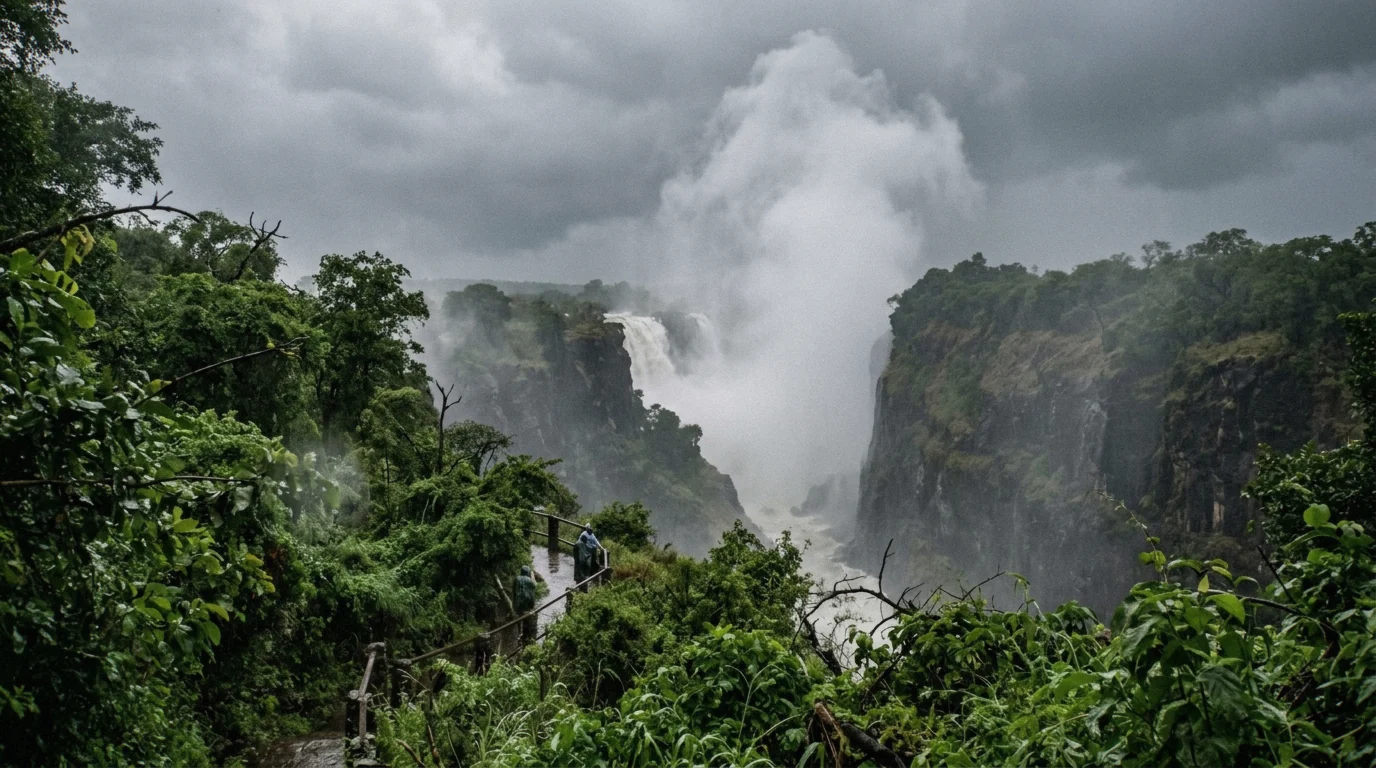
More spray means a stronger moonbow.
Photographing the Moonbow
The camera sees the moonbow better than you do, if you bring the right kit and settings.
Why the Camera Sees Color
The colors of a lunar rainbow are invisible or barely visible to the naked eye, but they show up clearly in long-exposure photographs because the sensor accumulates the faint light over many seconds. A journalist shooting at the falls found streaks of red, blue and violet hidden inside the pale white arc that the eye could see. This is the single best reason to bring a real camera rather than relying on a phone.
Settings and Gear
Recommended settings differ slightly between sources. Wild Horizons advises a tripod and a camera capable of exposures of 10 to 30 seconds, a wide-angle lens of 14 to 24mm to capture the full arc against the falls, and ISO between 800 and 3200 depending on moonlight brightness. A separate local guide suggests ISO around 800-1000, aperture at the widest the lens allows, about f/2.4, and shutter speeds of 8 to 15 seconds. Both approaches work, so experiment on the night.
Autofocus cannot lock in the dark, so set the lens to manual focus during daylight, focus at a distance just before infinity, and leave it locked. Use a self-timer or remote shutter release to avoid shake, and no flash of any kind, because flash ruins the image. A waterproof bag or cover for gear is essential because of heavy spray, especially in high water, and an umbrella and a dry lens cloth earn their place since spray still drifts onto equipment at night. Smartphone night modes can capture a faint moonbow but results are generally weaker than a manual camera on a tripod.
What to Wear
Wear dark clothing, because bright fabric reflects light and disturbs other viewers' photos. Paths can be slippery at night, so sturdy non-slip shoes matter. A waterproof jacket is worth having since spray still reaches visitors, and bring a small torch or head lamp, ideally with a red-light mode so you do not ruin others' photography or night vision.
In the winter months of roughly May to August add a warm jacket, while in summer light layers suffice as long as you stay dry from the spray.
Planning the Evening Around It
A moonbow night pairs naturally with time on the Zambezi before the park gates open.
Dinner or Sunset on the River First
The most straightforward plan is an early dinner cruise on the river, then the night park entry. The Pure Africa dinner cruise runs three hours with a four-course dinner cooked on board, drinks included and hotel transfers in Victoria Falls Town, from $110 per person with a $12 national park fee paid at check-in. If you would rather eat on land, the Zambezi Explorer sunset cruise with dinner at The Eatery gives you two hours on the water then three courses ashore.
Shorter on time? The two-hour sunset cruise on the Zambezi Explorer costs from $69 with canapés and drinks, which leaves the whole evening free for the rainforest gate. Sunset cruises typically board around 16:30 in summer and 16:00 in winter and last about two hours, so the timing works ahead of a moonrise viewing window. For the rest of a moonbow trip, see the list of things to do in Victoria Falls.
Booking and Getting There
Book the night viewing early. Wild Horizons recommends reserving as far ahead as possible because places on each night's tour are limited, particularly for the peak dates of March to June. Guide Omen Mudenda also recommends booking a guided tour ahead during peak periods, noting that a guide helps visitors move safely between viewpoints as conditions change through the night.
The viewing window is narrow, typically a few hours on each of the three nights, and there is no guarantee of a sighting even under good conditions, so plan more than one night if the moonbow is a priority. If you are staying in Livingstone and want to view from Zimbabwe side, the drive across Victoria Falls Bridge between the two towns is about 14 to 15 km, around 14 minutes excluding border time. Crossing needs passports and possibly a visa, and the KAZA UniVisa at $50 covers multiple entries between Zimbabwe and Zambia for up to 30 days.
Watch Before You Go
A third-party video, embedded from YouTube. We have no relationship with its creator.
Moonbow Questions
How rare is it to see a moonbow?
Genuinely rare. It is visible on only three nights of each lunar cycle, the night before, the night of, and the night after the full moon, and only for a few hours on each of those nights, soon after moonrise. Cloud, too much spray or the moon sitting too high can all kill it, and there is no guarantee of a sighting even under good conditions. Victoria Falls is widely cited as the most reliable place on earth to see one because of the scale of its spray column. See the full moon dates to pick your nights.
Can you see lunar rainbows at Victoria Falls?
Yes, and it is one of the best places in the world for it. The falls drop more than 100 meters and stretch more than 1.7 km across, producing enough spray for a moonbow on the three nights around each full moon. Both Victoria Falls National Park in Zimbabwe and Mosi-oa-Tunya National Park in Zambia open for night viewing on those nights. The best single viewpoints are on the Zambia side along the eastern cataract in high water, and Viewpoint 7 above the Devil's Cataract on Zimbabwe side.
What is the best month to go to Victoria Falls?
For a moonbow specifically, sources converge on the high-water window of roughly February to August, with June, July and August named as the balance of good spray and clear winter skies, and April and May producing the strongest displays but sometimes too much spray. For a first visit in daylight, the dry months of May to September bring comfortable temperatures, low humidity and almost no rain. The best time to visit guide breaks the seasons down.
When can I see the moonbow at Cumberland Falls in 2026?
Cumberland Falls in Kentucky is one of the few other places with recurring natural moonbows, alongside Yosemite Falls, Wallaman Falls in Australia and Kihei on Maui. The general rule travels anywhere: look for the three nights around each full moon, check the moonrise time, and go when the water flow is high. For Victoria Falls, the nights are in the full moon dates table.
How much does night entry for the Victoria Falls moonbow cost?
On Zambia side, night entry to Mosi-oa-Tunya National Park is reported at $25 per non-resident adult, separate from any daytime ticket, with evening access 18:00 to 24:00. On Zimbabwe side, published schedules differ: $50 is reported as the standard international adult entrance, one source reports $116 for moonlight entry, and an unverified summary reports about $100 for the full-moon night tour, with guided tours adding roughly $30 to $40 on top. Details and hours are in the tickets section.
Do I need a guided tour to see the moonbow?
No, on Zimbabwe side you can make your own way to the Rainforest entrance by taxi, pay the park fee and join the Zimbabwe Parks ranger-led group at the scheduled gate time, since walking after dark is discouraged because of elephant and buffalo in the area. A guided version adds hotel transfers and a private guide alongside the ranger. On Zambia side the park opens for the same three nights. Either way, book ahead, as places on each night are limited especially from March to June, and pair the night with a Zambezi River cruise earlier in the evening.