 Zambezi River Tours
Zambezi National Park: Animals, Game Drives, Fees and River Cruises
Zambezi National Park starts a few kilometres upstream of Victoria Falls town, which makes it the easiest safari option in the area. This guide covers what lives in the park, the two game drive routes, the lodges and fishing camps along the river, the entrance fees as far as they can be confirmed, and the best time of year to visit. It also explains how the park relates to the sunset cruises on the upper Zambezi, and how a game drive compares with a morning on the water when you plan your Zambezi river trips from Victoria Falls.
Quick answer Is it worth it?
Zambezi National Park covers 56,000 hectares of the Zambezi River upstream of Victoria Falls Town, with the main gate about 4.8 km from the town centre along Park Way Drive. Four of the Big Five live here (elephant, lion, buffalo and leopard, but no rhino), along with sable, eland, giraffe, kudu, zebra and more than 400 bird species. Most visitors actually see the park from the water, because the standard sunset cruises run on the river inside the park's stretch of the Zambezi.
Key takeaways
- See what lives here in the animals section.
- Check the entrance fees and gate hours, where published figures differ between sources.
- See the park from the river on the 2-hour sunset cruise.
- Read the full guide to the Zambezi River cruise experience.
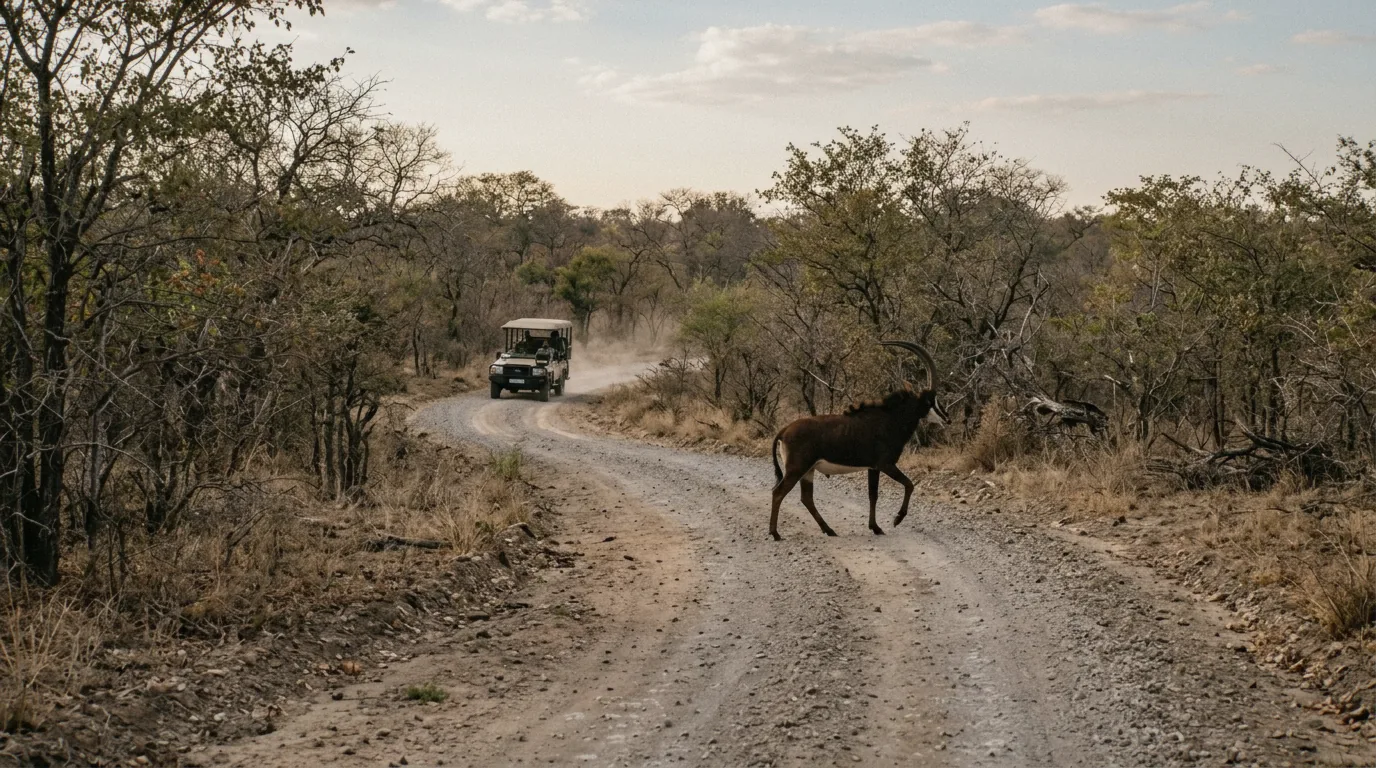
A game drive track through mopane woodland.
About Zambezi National Park
A short history and geography of the park that sits on Victoria Falls' doorstep.
Founded in 1979
Zambezi National Park was split off from Victoria Falls National Park in 1979 and gazetted as a park in its own right. It now covers 56,000 hectares (140,000 acres) with about 40 km of frontage along the Zambezi River. The park starts just upstream of Victoria Falls Town and stretches northwest toward Kazungula.
It is managed by the Zimbabwe Parks and Wildlife Management Authority (ZimParks).
The UNESCO strip
The World Heritage property of Mosi-oa-Tunya / Victoria Falls, inscribed in 1989, covers about 6,860 hectares across the two countries. A 741-hectare riverine strip of Zambezi National Park forms part of that inscription, alongside Victoria Falls National Park in Zimbabwe and Mosi-oa-Tunya National Park in Zambia. The UNESCO core zone also includes eight gorges that serve as breeding sites for birds such as the Taita Falcon and Black Eagle.
Two sides split by a road
The road from Victoria Falls to Kazungula cuts the park in two. West of the road lies the riverine side, where the Zambezi River Game Drive follows the riverbank and most animals concentrate. East and south lies the drier Chamabonda Vlei section, traversed by its own 25 km game drive.
Most of the park sits in the Zambezian and Mopane woodlands ecoregion, with a small southern portion in the Zambezian Baikiaea woodlands.
Sources: Zambezi National Park, national-parks.org, Zambezi National Park, Wikipedia
Animals in Zambezi National Park
Wildlife along the river and in the Chamabonda Vlei, and where you are most likely to see each species.
Mammals
Four of the Big Five are present in the park: elephant, lion, Cape buffalo and leopard. There is no rhino. The park is also known for herds of sable antelope, a species that is hard to find in many better-known reserves.
Hippos and Nile crocodiles are common on the upper Zambezi, and both are routinely seen from cruise boats as animals come down to the river to drink at dusk. Game viewing along the river is strongest in the dry months, when animals gather at the water.
Birds and fish
More than 400 bird species have been recorded, and the park's specialty birds include Pel's fishing owl, African skimmer, collared palm thrush, lanner falcon, goliath heron, African finfoot, rock pratincole and long-toed lapwing. In the river itself, 75 fish species have been recorded, including the famous tigerfish and bream, which is why the park's fishing camps have a following among anglers.
The table below pulls together the animals most people ask about, where in the park each is typically seen, and what the sources say about viewing conditions. Figures come from Wikipedia, ZimParks and national-parks.org.
| Animal | Where you see it | Notes |
|---|---|---|
| Elephant | Riverbank along the Zambezi River Game Drive | Often seen drinking at the river, sometimes from cruise boats |
| Lion | Both the riverine and Chamabonda sections | Present but sightings are not guaranteed |
| Leopard | Riverine woodland | Shy, best on dedicated game drives |
| Cape buffalo | Riverine and Chamabonda sections | Often in herds near water in the dry season |
| Sable antelope | Park-wide | A park specialty, hard to find elsewhere |
| Giraffe, kudu, zebra, eland, waterbuck, impala | Both game drive routes | Common game drive sightings |
| Hippo and Nile crocodile | The Zambezi River | Seen regularly from boats |
| Pel's fishing owl, African skimmer | Along the river | Two of the park's 400-plus bird species |
Game Drives, Walks and Cruises
How to actually see the park, from self-drive routes to guided drives, walking safaris, canoe trips and the sunset cruises.
The two game drive routes
The park has two main game-viewing routes. The Zambezi River Game Drive is an extensive road network along the river, entered through the main gate reached via Park Way Drive from town. The Chamabonda Game Drive is a 25 km loop through the wilder southern part of the park, starting about 5 km south of Victoria Falls town just off the A8 Bulawayo road.
Operators offer half-day and full-day guided game drives in the park, and you can also self-drive with a regular vehicle. Day trippers can use 25 numbered picnic sites along the river drive, shaded by trees such as the Natal mahogany, where picnicking and fishing are allowed.
Walking safaris and canoe trips
Guided walking safaris with a professional guide run inside the park, which is a different experience from a vehicle safari because you track animals on foot at their pace. Upper Zambezi canoe trips also put in inside the park and paddle back down the river past the park's riverbank. ZimParks recommends bringing binoculars, a camera, hiking shoes and a first-aid kit for any of these activities.
Lodges and fishing camps
A handful of private safari camps and lodges sit inside the park along the river, some on islands in the Zambezi, offering fully inclusive stays with their own game drives and boat cruises plus scheduled transfers into town. The park itself also has basic self-catering ZimParks lodges and campsites. Three named fishing camps sit on the riverbank just off the Zambezi River Game Drive: Kandahar, Siansimba and Mpala Jena.
These were historically public ZimParks campsites with flush toilets, cold showers and braai stands, but several have been allocated as private concessions, with Mpala Jena privatized in 2013 and Siansimba's redevelopment announced in January 2021. No published list shows which lodges currently operate inside the boundary, so check directly before planning an overnight stay.
Seeing the park from the water
Most visitors to Victoria Falls experience this stretch of the Zambezi on a sunset cruise rather than a game drive, and the cruises are the easiest wildlife outing in town. The two-hour sunset cruise on the Zambezi Explorer is the cheapest option, from $69 with canapes and drinks, and hippos, crocodiles and elephants are commonly seen on the upper river. If you want more time on the water, the dinner cruise on the Zambezi River runs three hours with a four-course meal cooked on board, and the sunset cruise and dinner combo at The Eatery pairs the two-hour cruise with a three-course dinner on land.
The cruises operate on the river within the park's stretch of the Zambezi, but they are not game drives: you see what comes to the water, and you will not cover the Chamabonda Vlei at all.
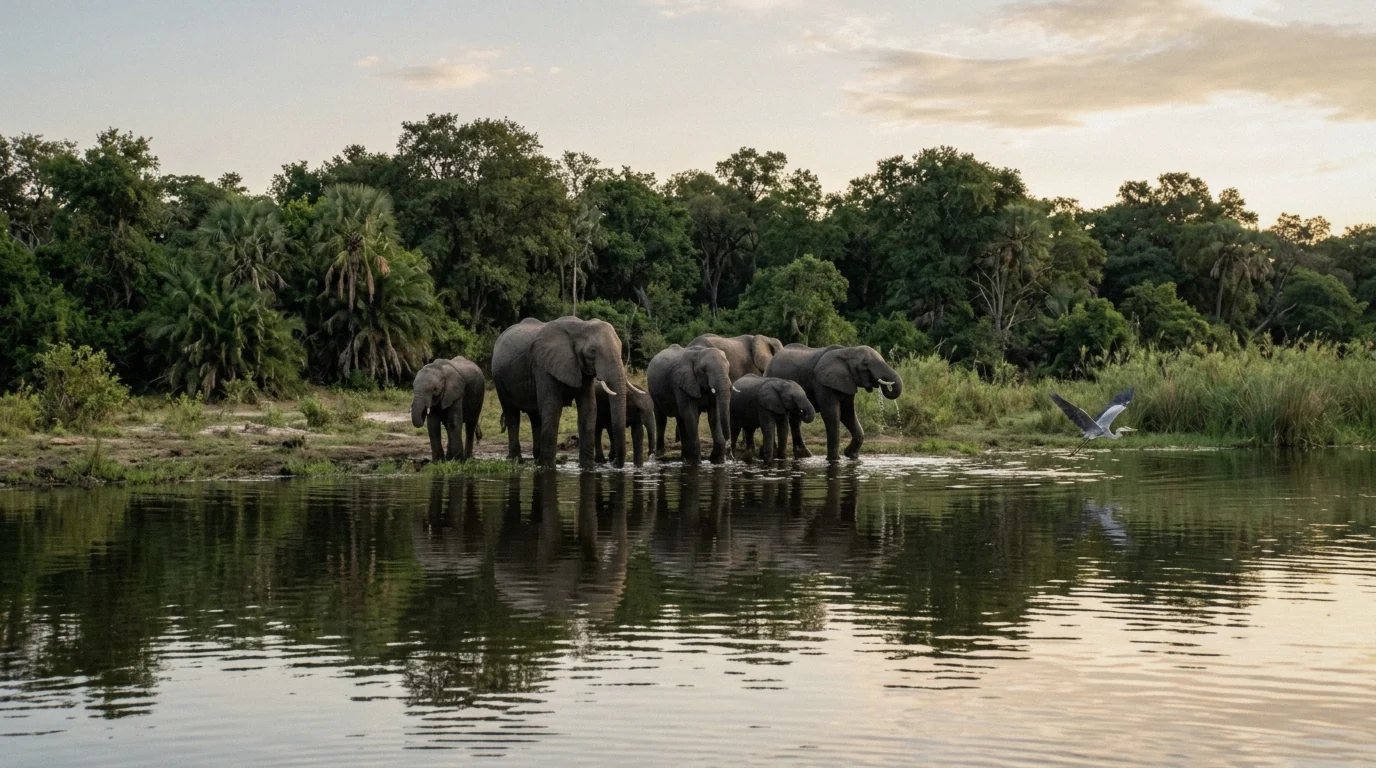
Elephants on the river frontage.
Entrance Fees and Opening Hours
What it costs to enter, and where the published figures stop.
Park entry fees
No official ZimParks-published per-park breakdown for Zambezi National Park specifically was located. A third-party source quotes roughly $15 per day for international visitors and $12 per day for SADC residents, with a lower ZWL rate for Zimbabwean residents. Children aged 6 to 12 pay 50 percent of the adult rate and under 6 enter free. Treat these as reported figures rather than settled prices.
The cruise listings are more concrete. On the Pure Africa cruises, the operator collects a national park fee of $12 per person at check-in, on top of the tour price. If you cruise rather than drive, you do not buy the day entry yourself.
| Fee | Amount | Source status |
|---|---|---|
| Park day entry, international adult | about $15 per day (reported) | Third-party source, no official schedule retrieved |
| Park day entry, SADC adult | about $12 per day (reported) | Third-party source, no official schedule retrieved |
| Children 6 to 12 | 50% of adult rate (reported) | Third-party source |
| Children under 6 | Free (reported) | Third-party source |
| Park fee collected on Pure Africa cruises | $12 per person at check-in | Stated on the tour listings |
| Zimbabwe Rainforest entry for comparison | $50 to $58 international adult | Published fee schedules differ |
Gate hours
The main gate is reported open from 6:00 AM to 6:00 PM daily. A separate source specifies April to October 6:00 AM to 6:00 PM and November to March 6:00 AM to 7:00 PM, reflecting longer summer daylight. Sources differ on the exact closing time, so confirm at the gate if you plan a late drive.
Best Time to Visit the Park
The dry season concentrates game along the river and makes wildlife viewing stronger.
Dry season for game, green season for scenery
Game tends to congregate toward the river in the drier months. Once the rains arrive around November and December, animals move inland to let the riverine vegetation recover, so game viewing along the river is typically stronger in the dry season. The dry months from roughly May to September also bring the most comfortable conditions overall, with daytime temperatures around 25.6 to 29.5C, low humidity and almost no rain. For a full month-by-month breakdown of weather, crowds and waterfall flow, see the guide to the best time to visit Victoria Falls.
For clothing, ZimParks recommends cool, comfortable clothing with sunhats and sunscreen in the summer months and warm layers for winter, especially at night. Earthy tones are advised over bright colours such as red, yellow or bright green.
Park Dos and Don'ts
Simple rules that keep you safe and keep the park worth visiting.
Do
- Do bring binoculars and a camera because ZimParks lists both in its recommended kit and much of the wildlife is far from the road.
- Do wear earthy tones because ZimParks specifically advises against bright colours such as red, yellow and bright green.
- Do use the 25 numbered picnic sites along the river drive because they are the designated places for day visitors to eat and fish.
- Do plan game drives for the dry season because animals gather at the river then and disperse inland after the rains.
- Do carry enough food, water and a first-aid kit because ZimParks recommends self-sufficiency and facilities inside the park are basic.
Don't
- Don't swim in the Zambezi because hippos and Nile crocodiles live in this stretch of the river.
- Don't expect rhino because the park holds four of the Big Five but no rhino.
- Don't count on a published official fee schedule because the figures in circulation are secondary and should be confirmed at the gate.
- Don't drive the Chamabonda route expecting river scenes because it crosses the drier vlei side of the park.
- Don't leave late drives to the last minute because reported gate closing times differ between sources, from 6:00 PM to 7:00 PM depending on season.
Watch Before You Go
A third-party video, embedded from YouTube. We have no relationship with its creator.
Frequently Asked Questions
Is Zambezi National Park worth it?
For visitors already based in Victoria Falls town, yes. The gate is about 4.8 km from the centre, so it works as an easy half-day or full-day trip without an overnight stay, and it is one of the few parks where sable antelope are a realistic sighting. Manage expectations: it is a convenient park rather than a big-name safari destination, and Botswana's Chobe offers stronger game viewing about 79 km away. If you only have one evening, a sunset cruise shows you the river side of the park for less effort.
Why can't you swim in the Zambezi River?
The upper Zambezi within the park has large hippo and Nile crocodile populations, and crocodiles make swimming dangerous anywhere along this stretch. Boats keep you safe, which is why every wildlife experience here happens on the water rather than in it. The one famous swimming spot on the river is Devil's Pool at the lip of the falls on the Zambia side, and only at low water with a guide.
Is Zambia or Zimbabwe safer for visiting the falls area?
The US State Department rates Zimbabwe at Level 2, exercise increased caution, and Zambia at Level 1, normal precautions. The UK FCDO publishes no numeric tier for either. Malaria risk is high on both sides of the border around the falls. Read the breakdown of Victoria Falls in Zimbabwe or Zambia to choose a side for practical reasons instead.
Which is the best national park in Zimbabwe?
Rankings depend on what you want. Zambezi National Park trades safari reputation for convenience, sitting on Victoria Falls' doorstep while Chobe across the border is internationally renowned for game viewing, especially elephants. For many visitors the practical answer is to combine a game drive or cruise here with the falls themselves.
How much does it cost to enter Zambezi National Park?
No official ZimParks tariff for this park is published in a form that confirms the figure. A third-party source reports about $15 per day for international visitors and $12 for SADC residents, with children aged 6 to 12 at half price. On the cruise listings, the operator collects a $12 park fee per person at check-in on the Pure Africa sunset cruise, so you do not pay the day entry separately.
Can you see the Big Five in Zambezi National Park?
Four of the Big Five: elephant, lion, Cape buffalo and leopard are all present, but there is no rhino. Sightings of predators are not guaranteed on a short visit, while elephants, hippos, crocodiles and plains game such as sable, giraffe and kudu are the more realistic highlights. A morning game drive pairs well with an evening dinner cruise on the river.